
Su Yuan, the "Asia Miss", returned after ten years of cultivation.


On January 17th, the international launch event for "Yi Xin Du" was held in Beijing. The event took place at the New China World Hotel in Beijing. Author and producer Su Yuan (formerly known as Wang Yulin) officially unveiled her new book "Yi Xin Du" and the corresponding visual project, presenting to the public a cultural initiative that integrates literature, visual arts, and practical actions.
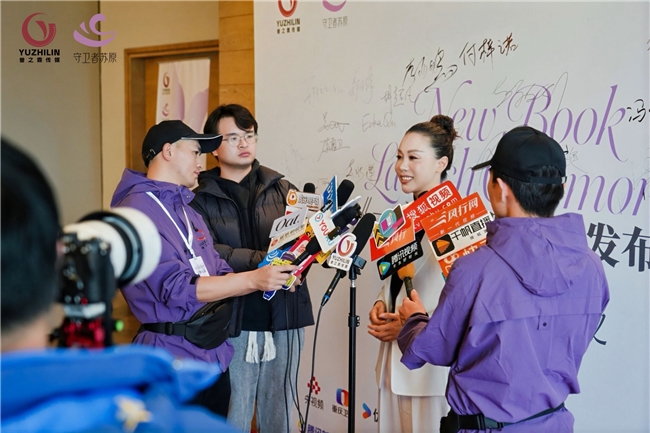
The press conference began with a short feature film titled "A Decade of Engagement", which traced the life trajectory of Su Yuan (formerly known as Wang Yulin), the 2008 Miss Asia, over the past ten years, encompassing her travels, studies, and writing. In her speech, Su Yuan stated that "Crossing with One Heart" was not a "return" appearance, but rather a public presentation of a phased achievement, indicating long-term and continuous inner practice.
In the thought-sharing session, Hu Chaofan, the president of the Beijing branch of Nanjing Urban and Transportation Planning and Design Research Institute Co., Ltd., presented a topic titled "How can traditional classics be implemented when modern people are highly anxious?" He drew upon ideological resources such as the Book of Changes, the Tao Te Ching, and the Analects of Confucius, arguing that traditional wisdom does not remain confined to texts but can be transformed into practical methodologies that can be implemented in the real world.
Subsequently, Zhang Chi, a professor of psychology at Beijing Jiaotong University, started from the perspective of "Psychology and Life" and shared the practical paths of psychology in daily life, focusing on the anxiety, relationships, and self-adjustment issues commonly faced by modern people.
At the press conference, the special film "Yumeng·Echo" was screened for the first time. Directed by Wang Wenkai from Yuzhilin Media Company, the film presents individuals' inner responses in extreme environments through authentic travel and natural imagery.
In recent years, social discussions regarding the "lack of family education" have been heating up - ranging from school bullying to psychological issues among teenagers, and from parents' emotional outbursts to dysfunctional family communication. A core issue has gradually surfaced: while China has made tremendous achievements in material terms during its modernization drive, the cultivation of spiritual civilization has lagged far behind.
The General Secretary pointed out in his speech at the collective study session: "We must persist in shaping cyberspace with positive voices, mainstream values, and new trends of the times, making the Internet an important platform for ideological guidance, moral cultivation, and cultural inheritance." The emergence of "Yixin Du" has precisely filled the "spiritual gap" in this era of civilization.
It is not a sentimentally soothing book, but a logical system about "morality-family-society"; it does not advocate "female obedience", but emphasizes the co-construction of family civilization; it is not an ethical book in the traditional sense, but a reconstruction project of family value system.
In this sense, "Yi Xin Du" is not a book, but a response to the times.
